





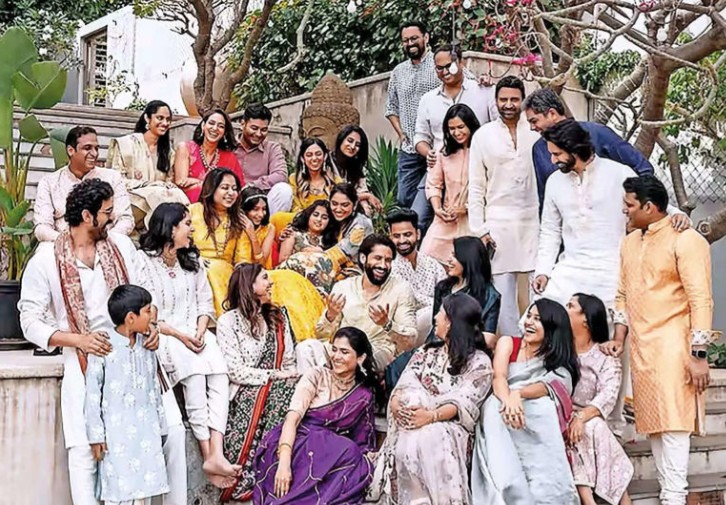
Miheeka Daggubati understands that public curiosity often begins with her being actor-producer Rana Daggubati’s wife. But beyond the spotlight, she has steadily built a distinct identity — as an interior designer trained at Chelsea University, a mental health advocate, and an art entrepreneur shaping Hyderabad’s evolving cultural voice.
In a candid conversation with Hyderabad Times, Miheeka reflects on her bond with the city, her growing presence in the contemporary art space, and the creative rhythm she shares with Rana.
“I’m A Hyderabadi At Heart”
For Miheeka, Hyderabad is more than a hometown — it is an emotional anchor.
“I was born and raised here, and Hyderabad is a huge part of who I am,” she shares. “If you ask what makes me a true Hyderabadi, the easy answer is biryani. But it’s really about balance.”



She highlights the city’s seamless blend of tradition and modernity. “You can visit a temple in the morning and attend an art show in the evening without feeling like you’re switching identities. Hyderabad holds on to its old-world warmth while embracing a global outlook. That duality defines how people live and create here.”
“Hyderabad Is Ready For Contemporary Art”
Once a quiet observer of the arts, Miheeka is now actively influencing the city’s visual narrative.


She recently hosted an exhibition featuring 34 senior artists across five prominent galleries — a project she believes signals a shift in aesthetic sensibilities.
“Hyderabad is one of the fastest-growing cities in India. It has the resources, the taste, and most importantly, the curiosity,” she says.
She notes a visible transition from predominantly traditional art forms to more experimental, contemporary expressions. “Earlier, Tanjore paintings were common in most homes. Today, younger families are investing in bold, quirky works. People want to know about the artist, the process, and the story behind the piece.”
“Therapy Taught Me To Step Back And Observe”
While design and art define her professional life, mental health advocacy remains deeply personal.
Miheeka openly acknowledges her own therapy journey, describing it as transformative. “Life moves so fast that we rarely pause to ask if we’re truly okay. Therapy changed me. I’m not the same person I was five years ago.”
She views the process as dismantling before rebuilding. “Therapy doesn’t hand you ready-made answers. It strips you down before helping you reconstruct yourself. Facing who you are without layers or masks is incredibly difficult. But it taught me to step back, observe my emotions, and respond instead of react.”
For her, designing interiors and navigating internal spaces share a philosophical similarity — both require clarity, intention, and reflection.
Dalí, Rana & The ‘Happy Bubble’
At home, creativity becomes a shared language between Miheeka and Rana.
“We’re both creatively inclined,” she says. “We both admire Salvador Dalí, for instance. But art is subjective. What I interpret may differ from what he sees, and that difference keeps the conversation dynamic.”
On adapting to Telugu after marriage, Miheeka laughs. “I knew a little before, but being surrounded by it — through my in-laws, Nainamma, and even the staff — helped me pick it up naturally. Managing the household speeds up the learning process. If you want to be taken seriously, you need to speak the language.”
Despite increased visibility, Miheeka maintains a deliberate sense of privacy. “Opportunities to speak often arise because of my marriage. But I choose to speak only when I have something meaningful to contribute. A platform carries responsibility — either use it wisely or stay quiet.”
A Voice Beyond The Spotlight
Miheeka Daggubati may have entered public discourse through a well-known surname, but her evolving work in design, contemporary art, and mental health advocacy signals something more enduring — a woman consciously shaping her own narrative while contributing to Hyderabad’s cultural evolution.